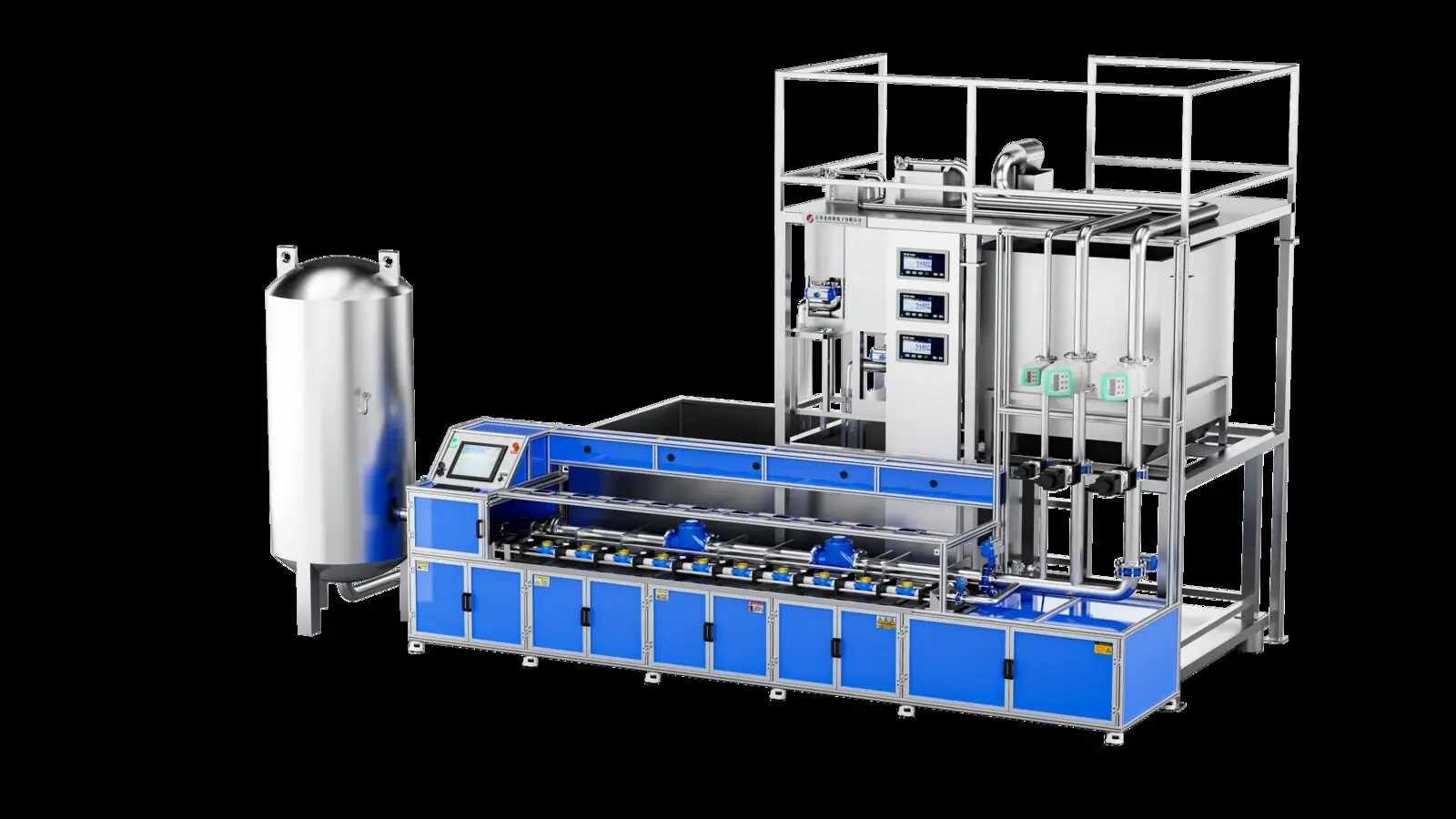
Understanding the Principles Behind Water Meter Testing Equipment
Water meters play an important role in measuring water consumption in residential, commercial, and industrial applications. But how can manufacturers and testing laboratories determine whether a water meter measures water flow correctly?
A water meter testing bench provides a controlled environment for evaluating meter performance. By comparing the readings of a meter under test with a reference measurement, operators can assess its measurement error under specified test conditions.
In this article, we explain the basic principles of water meter testing and the key components of a testing system.
What Is a Water Meter Testing Bench?
A water meter testing bench is equipment designed to evaluate the flow-measurement performance of water meters.
A typical system may include:
- Water supply system: Provides the water required for testing.
- Pipeline system: Connects the meters under test and controls the water flow path.
- Reference measuring equipment: Provides the reference measurement used for comparison.
- Flow control components: Help establish the required test conditions.
- Timing and data acquisition systems: Record relevant measurements and support result evaluation.
The exact configuration depends on the testing method, meter specifications, and intended application.
How Does the Testing Process Work?
Although procedures vary by system, a typical test follows several basic steps.
Step 1: Install the water meters
Place the meters in the designated test positions and check the connections to ensure that the test setup is ready.
Step 2: Establish the required flow conditions
Adjust the water supply and flow-control system to achieve the specified test conditions. Stable flow conditions are important for obtaining consistent measurements.
Step 3: Collect measurement data
Record the readings from the meter under test and the reference measuring system. Depending on the equipment, measurements may be obtained through weighing, reference meters, standard vessels, or other suitable methods.
Step 4: Evaluate the measurement error
Compare the meter’s indicated volume with the reference volume to determine the measurement error.
A commonly used expression for relative indication error is:
Relative error (%) = [(Indicated volume − Reference volume) / Reference volume] × 100%
The applicable test procedure determines how the readings are collected, processed, and evaluated.
Step 5: Record the results
A testing system may record test conditions, measurement data, and calculated results. Automated equipment can help reduce repetitive manual operations and improve the consistency of data collection.
Common Methods Used in Water Meter Testing
Different testing methods offer different advantages and limitations.
Gravimetric method
This method determines the collected water mass using a weighing system. The corresponding water volume can then be calculated using the appropriate water-density value and test conditions.
Reference meter method
The meter under test is compared with a reference meter whose performance has been appropriately established. The reliability of the reference meter is essential to the quality of the results.
Reference vessel method
A calibrated vessel is used as a volume reference. This method can be suitable for performance testing, depending on the test requirements and equipment configuration.
Time-based flow measurement
Some systems use flow measurement and elapsed time to determine the volume passing through a test section. The measurement principle and instrumentation must be appropriate for the required test conditions.
The choice of method should be based on the required measurement performance, testing purpose, equipment configuration, and applicable technical requirements.
Why Does Automation Matter?
As water meter manufacturing develops, testing equipment must support both reliable measurement and efficient production.
Automated water meter testing equipment can integrate flow adjustment, sensor data acquisition, test sequencing, and result recording into a coordinated process.
Multi-position systems can also support the testing of multiple meters, depending on their hydraulic design and control configuration.
However, automation alone does not guarantee measurement accuracy. Reference equipment, flow stability, installation conditions, water temperature, air management, and the validation of the test procedure must all be considered.
Choosing the Right Testing Equipment
Before selecting a water meter testing bench, manufacturers and laboratories should consider several questions:
- What types and sizes of water meters need to be tested?
- Is the primary goal production calibration or detailed performance testing?
- How many meters need to be tested per batch?
- Which reference measurement method is appropriate?
- What level of automation is required?
- What installation space, maintenance access, and budget are available?
Answering these questions helps identify an equipment configuration that fits the actual application rather than simply choosing the most complex system.
Conclusion
Water meter testing combines controlled flow conditions, reliable reference measurements, and systematic data evaluation. A well-designed testing bench helps manufacturers and laboratories assess meter performance and organize testing operations more effectively.
At Jiangsu JinYuMing Electronics Co., Ltd., our technical development experience includes multi-position water meter testing equipment and integrated automatic testing systems.
Looking for a water meter testing solution?
Contact our team to discuss your meter specifications, testing objectives, and automation requirements.